GEV blog
The SEAI apartment charging grant is fully committed for 2026: what Irish OMCs should do now
11 min read
As of 10 November 2026, the Sustainable Energy Authority of Ireland (SEAI) says the EV Apartment Charging Scheme is fully committed for 2026 and it is not accepting any more applications for projects this year. When the scheme is open, an owners’ management company can receive up to 80% of SEAI’s approved eligible costs, subject to a cap of the lower of €5,000 per dwelling or €100,000 for the development, and up to €600 per charging outlet. Only costs needed to make up to 50% of parking spaces “EV-ready” are treated as eligible. A resident cannot apply for that network grant alone — the OMC, or another eligible body, applies with an SEAI-registered charge point operator. While the 2026 window is closed, a property manager can still survey the site, gather quotes and get board approval so the development is not starting from scratch if a further round is announced. Check the SEAI apartment charging grant page before you act, because scheme status and figures can change.

What is the SEAI apartment charging grant, and is it still open?
The apartment charger grant is a Zero Emission Vehicles Ireland (ZEVI) scheme, administered by SEAI, for bulk installation of a charging network in the common areas of apartments and other multi-unit developments that are not covered by the ordinary home charger grant. SEAI says it supports cabling, infrastructure, labour, construction costs and charge points.
On the official grant page, SEAI states: “The SEAI EV Apartment Charging Scheme is now fully committed for 2026. As a result, we are unable to accept any more applications for projects in 2026.” Its application guide (Version 01.1, dated 12 February 2026) says funding is awarded as applications are submitted, until the available budget has been fully allocated. That is a budget fact, not a change to the published rules. SEAI has not, on the pages fetched for this article, published a reopening date or confirmed the terms of any later round. This briefing is not a substitute for SEAI’s application guide and terms. GEV’s residential charging page and guide for property managers cover the same theme as a service overview.
Who can apply, and which developments are excluded?
SEAI lists owners’ management companies, management companies of build-to-rent developments, local authorities and approved housing bodies as eligible applicants. The scheme is aimed at multi-unit developments with two or more units that share facilities and services, where shared or private parking is available, but where there is no dedicated private off-street parking within the boundary of each individual property. That includes apartments, houses, duplexes or a mix.
Landlord rules differ between two official documents. The grant webpage says landlords who own one or more units may be eligible under the home charger grant, but only for a bulk installation. The application guide describes landlords who own 10 or more units, and says that if the management company will not apply, or if fewer than 10 chargers are planned, the landlord should use the home charger grant for each unit. Ask SEAI at EVChargers@seai.ie if that is your situation.
Two exclusions catch boards out. New builds and major renovations, as defined by S.I. No. 393/2021, are not entitled to support: SEAI says residential buildings with 10 or more parking spaces in that category must already include EV infrastructure, and the exclusion applies to developments that issued a commencement notice from 10 March 2021 onwards. A resident with an assigned bay cannot usually go it alone, because the parking area is typically common property. Irish apartment owners on forums such as r/evs_ireland come back to the same point — the practical path is a board or AGM decision, not a private cable run.
How much funding can an OMC actually get?
The headline “up to 80%” is real, but it is not the whole story. SEAI publishes three support rates, then applies caps that often decide the final award.
| Applicant type | Funding level (% of approved eligible costs) | Overall cap | Cap on the charge point itself |
|---|---|---|---|
| Local authority or approved housing body | 90% | The lower of €5,000 per dwelling or €100,000 for the development. No development receives more than €100,000, including across more than one application. | The lesser of the actual cost of the unit or €600 per charging outlet. A dual unit with two outlets is capped at €1,200. |
| Owners’ management company | 80% | Same caps | Same caps |
| Management companies of build-to-rent developments | 60% | Same caps | Same caps |
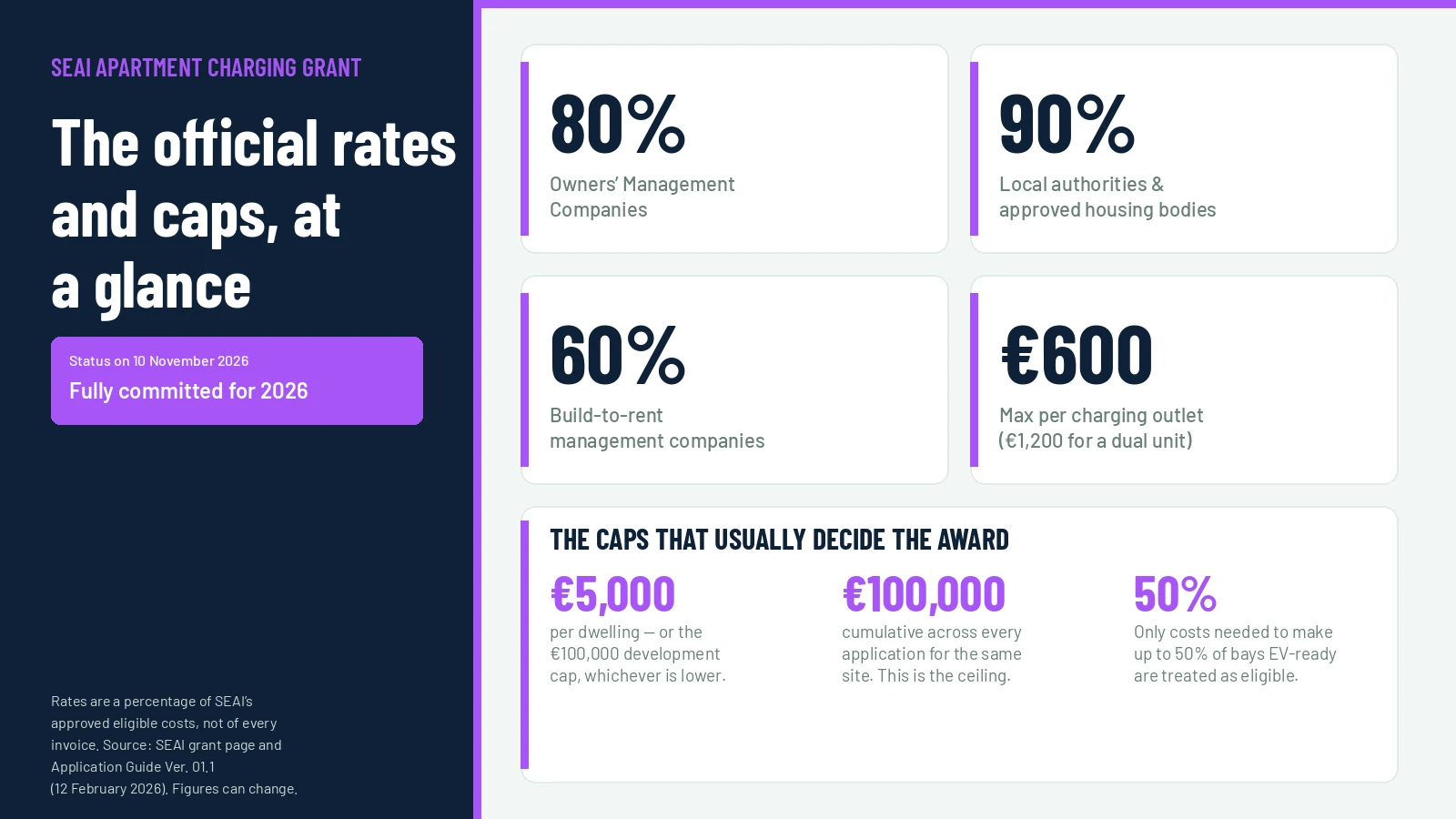
The 50% EV-ready rule. SEAI will only treat as eligible the civil works, cabling and charging outlets needed to enable 50% or less of the total parking spaces with a charging outlet or as “EV-ready”. EV-ready, in the guide, means ducting or containment capable of carrying a suitable cable already passes the space, so a charger can be connected later without a fresh trench. Work above that 50% threshold is not an eligible cost.
VAT can be included — if you cannot recover it. In SEAI’s own example, an OMC project with approved eligible costs of €30,000 before VAT and €36,900 once VAT is included would receive 80% of €36,900, or €29,520, if the OMC cannot recover VAT and can prove that status; or 80% of €30,000, or €24,000, if it can recover VAT. These figures are an official worked example, not a quote for your site.
The per-dwelling cap often bites first. In SEAI’s approved housing body example, 14 dwellings and a large project cost produce an initial award estimate well above the cap, so the grant is limited to 14 × €5,000 = €70,000. A high-cost car park does not automatically receive 80% or 90% of the contractor’s invoice. Multiple applications for the same development are possible, but two cannot be live at the same time, and further applications still sit under the same cumulative cap.
What costs does the grant cover — and what does it leave out?
Eligible categories in the guide include an ESB connection or upgrade, capped at the ESB Networks Statement of Charges at the time; civil works, including trenching, at a maximum of €3,000 plus €248 per metre (assessed ex VAT, and only for work needed to make up to 50% of spaces EV-ready); cabling, ducting, switchgear and signage; load-management equipment that keeps the site within its maximum import capacity; charging units, subject to the €600 per-outlet cap; electrician labour; and project management, design or survey costs, capped at 7% of total eligible project costs.
Ineligible costs include any spend before or after the letter of offer, standing charges, ongoing management or maintenance fees, electricity and insurance, work required to enable more than 50% of parking spaces, and remedying defective work previously done by others. No works should start before SEAI approves the application, and all costs must be incurred and paid within the period of the offer. If a letter of offer is issued, the signed grant agreement must be returned within 14 days or the offer does not become valid.
Route 1 or Route 2: does your car park already have a network?
SEAI describes two routes, and they are not interchangeable.
Route 1 — no existing charging network. The company that manages the complex applies for the apartment charger grant with a registered charge point operator. SEAI’s overview says it will provide up to 80% funding for infrastructure costs and will also offer €600 per charge point installed. The management company can make its own arrangements with residents to cover any difference if a resident is to own the charger.
Route 2 — a network is already in place. A resident should contact the management company, or the operator already running the system, for permission to join, the equipment that must be used, and how payment works. The resident can then apply for a home charger grant. SEAI says that grant is the lesser of €300 or 100% of the installation cost, and the charger must be one that appears on the list in the online application.
Ageing or orphaned hardware is still a Route 2 conversation first — you have a network, even if it is failing — but the OMC may also need a broader upgrade. GEV’s Clongriffin success story describes a block-by-block migration after the EO platform shut down. Do not assume an old system automatically qualifies for a fresh apartment grant.
How should a property manager prepare while the 2026 scheme is closed?
You cannot submit a 2026 application if SEAI is not accepting them. You can still do the work that every successful application has required.
Get a clear picture of the site: dwellings, parking spaces, assigned bays, the existing electrical supply, and whether a new ESB connection or MIC upgrade is likely. SEAI also asks for a schematic showing cable routes, trench lengths and how many spaces will be made EV-ready versus how many charge points will be installed now. That drawing is what SEAI uses to assess civil-works allowances and the 50% rule.
Applications must be made with an SEAI-registered charge point operator. SEAI recommends three independent quotes where possible. The CPO is not only an installer: it will handle billing, maintenance and support for years after installation, and must advise on capacity and load management. Only applications that list a registered CPO are considered. The OMC should confirm that insurance and tax clearance are current. GEV, legally GlenEV Technologies Ltd, is listed on that official CPO register.
Take a proposal to the board or AGM that answers liability, who pays, and whether charging will land on the service charge. Residents can pay through the operator’s billing platform, and the design can start with live chargers plus EV-ready bays. Do not start digging: works begun before a letter of offer are ineligible. A free site assessment or consultation with GEV is preparatory work, not a grant application.
Why cabling and load management matter more than the chargers themselves
The expensive, disruptive part of apartment charging is usually the shared infrastructure: trenches, ducts, a dedicated supply, and the load-management system that keeps the site within its MIC. The charge point on the wall is the visible piece, and the piece SEAI caps at €600 per outlet. That is why a grant-aware design spends effort on the backbone.
GEV’s apartment projects illustrate the approach. They are not a promise that every site will look the same, and they are not evidence that the grant paid for every bay. At The Pavilion in Dún Laoghaire, all 101 bays were cabled on day one, with a dedicated new ESB supply and 22 chargers live, and the maximum SEAI grant was secured on the infrastructure. At Bastion Quay in Athlone, all 51 allocated bays were cabled and 13 chargers were live. Addison Park started in the visitor bays; The Casino in Malahide installed 12 Easee 22 kW chargers after an MIC increase. Further examples are on the success stories page, including Wingfield and Neptune at Honeypark.
Those figures come from GEV’s published case studies. The 50% EV-ready rule still applies: cabling above that threshold is a design choice, but it is not an eligible cost. Residents also need a way to pay for what they use; at GEV that is GEVTopUP.
What to do next
If residents are already asking for chargers, the closed 2026 window is not a reason to put the file back in the drawer. It is a reason to get the site understood, the quotes in and the board aligned before the next opportunity — if and when SEAI announces one.
Request a free site assessment from GEV, or book a 30-minute consultation. We will review the property, map a grant-aware layout and talk through what SEAI’s published rules would mean for your development. For the official status, rates and application documents, use SEAI’s apartment charging grant page.
FAQs
Is the SEAI apartment charging grant still open in 2026?
No. As of 10 November 2026, SEAI says the scheme is fully committed for 2026 and cannot accept any more applications for projects this year. Check the official SEAI page for any later change of status. This article does not claim a 2027 reopening date.
Can an individual resident apply for the apartment charging grant?
Not for the network itself. The OMC or another eligible body applies, with a registered charge point operator. If a network is already in place, a resident may be able to apply for the separate home charger grant — the lesser of €300 or 100% of the installation cost — once the management company has given permission to join.
Does the grant pay to cable every parking bay?
Not necessarily. SEAI only treats as eligible the work needed to make up to 50% of parking spaces EV-ready or equipped with a charging outlet. An OMC can still cable more of the car park, but the extra sits outside the eligible cost. The €5,000-per-dwelling and €100,000 caps can also reduce the award below the headline rate.
Can we start installation now and claim the grant later?
No. Works must not start before SEAI approves the application, and costs that predate or fall after the letter of offer are ineligible. While the 2026 scheme is closed, limit site work to surveys, design and board approvals.
What if our development started construction after 10 March 2021?
Developments that issued a commencement notice from 10 March 2021 onwards, and buildings undergoing major renovations as defined by S.I. No. 393/2021, are excluded where the building regulations already required EV infrastructure. Newer schemes may still need a charging design and an operator; they should not budget on this particular grant.
What should our OMC do while applications are closed?
Commission a site survey, get quotes from more than one SEAI-registered charge point operator, prepare a car-park schematic, and put a costed, grant-aware proposal to the board or AGM. Confirm VAT-recovery status, then watch the official SEAI page for any new application window. GEV can start with a free site assessment.